What Is Agile Software Development? Agile Methodology Overview
Agile Software Development is a software development approach that emphasizes flexibility, collaboration, and continuous improvement, rather than following a rigid plan from the outset. Agile divides projects into small increments delivered through short iterations, enabling early and frequent value delivery while allowing teams to quickly adapt to changes based on feedback from customers and stakeholders.
What is the core of agile software development?
Agile is not merely a software development methodology; it is a mindset and philosophy centered on delivering real value to customers. The core of Agile lies in building an environment of continuous collaboration, rapid feedback, and the ability to adapt flexibly to change. To better understand this, Agile is built upon the following five foundational principles:
Customer value comes first
The ultimate goal of Agile is to deliver working software that solves real user problems.
It prioritizes the highest-value features, delivering them early and frequently rather than waiting months for a “perfect” product.
Flexibility in adapting to change
Agile acknowledges that changing requirements are inevitable, even in the later stages of a project.
Instead of resisting change, Agile embraces it as an opportunity for the product to evolve and more accurately meet real market and user needs.
Iterative and incremental delivery
Work is broken down into short cycles (Sprints/Iterations), typically lasting 1–4 weeks.
Each cycle produces a working product increment, enabling frequent releases and rapid course correction.
Collaboration and effective communication
Agile breaks down silos between teams. Close collaboration among the development team, stakeholders, and customers is essential.
Face-to-face and continuous communication is valued over rigid documentation or cumbersome administrative processes.
Continuous feedback and ongoing improvement
Agile teams regularly review their work through practices such as Sprint Reviews and Retrospectives.
Feedback from users and internal teams is continuously gathered to improve both the product and the working process in subsequent cycles.
In summary, the true strength of Agile lies in transforming the complexity and uncertainty of software development into a flexible, transparent, and value-driven journey, where customers and development teams move forward together.
Key Characteristics of Agile software development
Beyond its foundational principles, Agile is clearly reflected in practical, tangible characteristics of how work is carried out. Below are five key characteristics that define an effective Agile process:
Iterative Development
Large projects are broken down into short development cycles known as Sprints, typically lasting from one to four weeks.
Each Sprint represents a complete iteration, including planning, analysis, design, coding, and testing.
This iterative approach helps control risk, reduce complexity, and establish a stable working rhythm for the team.
Frequent Releases
The goal of each Sprint is to produce a product Increment that is genuinely runnable and usable.
Agile teams aim to continuously deliver value to users, enabling early market releases and the collection of real-world data.
Feedback-Driven Approach
The product is continuously refined based on feedback from customers and stakeholders after each Sprint Review.
This forms the Agile feedback loop: Build → Measure → Learn, ensuring the product remains aligned with real user needs.
Cross-Functional and Self-Organizing Teams
A typical Agile team includes all roles required to deliver a complete feature, such as Developers, Testers, Designers, and a Product Owner.
Team members collaborate closely throughout the Sprint, breaking down functional boundaries and focusing on the shared goal of delivering high-quality software.
Teams are empowered to decide how best to accomplish their work.
Continuous Improvement
After each Sprint, the team conducts a Sprint Retrospective to reflect on the way they worked. Together, they evaluate what went well, what did not, and what needs to change. The objective is to continuously optimize performance and workflows, making Conclusioneach Sprint better than the previous one.
These characteristics form a closed-loop Agile ecosystem: iterative development to create value, frequent releases to deliver value, feedback to refine value, and continuous improvement to enhance the team’s ability to generate value. This combination is the key driver behind Agile’s adaptability and speed.
Agile Frameworks: Turning Mindset into Concrete Action
An important point to understand is that Agile is a mindset or a set of principles, not a single, prescriptive methodology. To apply this mindset in practice, organizations rely on frameworks. Below are the most common Agile frameworks, each with its own focus and approach to realizing Agile values.
1. Scrum – The Most Popular Framework for Product Development
Core concept: Work is organized into fixed-length iterations called Sprints (typically 2–4 weeks), with the goal of delivering a working product Increment at the end of each Sprint.
Key characteristics:
- Time-boxed events: Sprint Planning, Daily Standup (15 minutes), Sprint Review, Sprint Retrospective.
- Clearly defined roles: Product Owner (product direction), Scrum Master (process facilitation and protection), Development Team.
Management artifacts:
- Product Backlog (prioritized list of all work).
- Sprint Backlog (work committed for the current Sprint).
Best suited for: Product development projects with frequently changing requirements that need clear structure and a stable delivery cadence.

2. Kanban – Flexible Optimization of Workflow
Core concept: Visualizing the entire workflow (from “To Do” to “Done”) on a Kanban board, with a strong focus on managing and improving flow.
Key characteristics:
- High visual transparency: Columns and cards clearly show work status and progress.
- Work-in-Progress (WIP) limits: Help maintain focus, reduce overload, and identify bottlenecks.
Flexibility:
- No fixed Sprints; releases can occur at any time once work is completed.
Best suited for: Maintenance, support teams, or teams with uneven incoming work that need to optimize throughput and efficiency.

3. Extreme Programming (XP) – Putting Technical Excellence First
Core concept: A strong emphasis on code quality and engineering practices to effectively adapt to changing requirements.
Key characteristics:
- Engineering practices: Pair Programming, Test-Driven Development (TDD), Continuous Integration (CI), simple design.
- Strict discipline: Technical practices are rigorously followed to keep the codebase clean, flexible, and maintainable.
Best suited for: High-risk projects with frequently changing requirements, where code quality is critical to success.
4. SAFe / LeSS – Scaling Agile for Large Enterprises
Core concept: Scaled Agile frameworks that enable multiple Agile teams (from dozens to hundreds of people) to collaborate on complex products or systems.
Key characteristics:
- SAFe (Scaled Agile Framework): Provides structured roles, processes, and governance at the Portfolio, Program, and Team levels. Suitable for large organizations that require strong alignment and control.
- LeSS (Large-Scale Scrum): Extends Scrum principles to large-scale environments in a minimalist way, focusing on scaling the mindset rather than adding process layers.
Best suited for: Large enterprises with multiple teams working together on a single product or a complex product portfolio.
Conclusion
The choice of framework depends on an organization’s context, goals, and culture. Some teams even combine elements from multiple frameworks (such as Scrumban) to create a way of working that best fits their needs. Ultimately, the most important factor is maintaining the Agile mindset—flexibility, value focus, and continuous improvement—regardless of which framework is used.
Agile Software Development Process: An Iterative and Adaptive Lifecycle
Unlike the linear Waterfall model, the Agile process is an iterative and adaptive cycle executed within each Sprint. Every iteration (typically lasting 1–4 weeks) goes through the following core stages to produce a working product Increment.
1. Concept and Initiation
Objective: Define the overall scope, market opportunity, and core value of the product.
Key activities:
- The Product Owner and stakeholders define the product vision.
- An initial Product Backlog is created, consisting of high-level features (Epics/User Stories).
- Feasibility assessment and initial prioritization are performed.
2. Requirements Gathering and Refinement
Objective: Break down requirements into actionable and estimable work items.
Key activities:
- Large Epics are decomposed into smaller, concrete, and testable User Stories.
- Acceptance Criteria are clarified for each User Story.
- This is an ongoing activity that takes place before and during each Sprint, not a one-time phase at the start of the project.
3. Sprint Planning
Objective:
Define the goal and specific work for the upcoming Sprint.
Key activities:
- The development team and Product Owner select User Stories from the Product Backlog for the Sprint.
- User Stories are broken down into technical tasks, estimated, and committed to by the team.
- The outcome is a Sprint Goal and a Sprint Backlog.
4. Design and Development
Objective: Build working software that meets the Acceptance Criteria.
Key activities:
- Architecture and UI design are performed at a level sufficient for the Sprint.
- Coding activities (often using practices such as Pair Programming and TDD when XP is applied).
- Continuous Integration (CI) ensures the codebase remains in a releasable state.
- Daily Standups (15 minutes each day) are held to synchronize progress and surface impediments.
5. Testing
Objective: Ensure software quality and correctness.
Key activities:
- Testing is integrated continuously into development rather than treated as a separate phase.
- Testers are involved early and collaborate closely with developers.
- Automated testing, functional testing, and regression testing are conducted to ensure new increments do not break existing functionality.
6. Sprint Review and Retrospective
Objective: Inspect and adapt both the product and the process.
Key activities:
- Sprint Review: The completed Increment is demonstrated to the Product Owner and stakeholders to gather direct feedback. The Product Backlog may be adjusted accordingly.
- Sprint Retrospective: The development team reflects on the working process. What went well? What did not? What improvements will be applied in the next Sprint?
7. Release and Deployment
Objective: Deliver the software to users.
Key activities:
- Preparation of the production environment.
- Deployment of the Increment. In an ideal Agile setup, this can occur after every Sprint or even continuously through Continuous Deployment.
8. Maintenance and Product Evolution
Objective: Ensure stable operation and continued product growth.
Key activities:
- Handling production issues and defects.
- Collecting real user feedback to generate new User Stories.
- Maintenance and enhancement requests are added to the Product Backlog, prioritized, and implemented in subsequent Sprints. This completes one iteration and initiates the next.
These stages are not linear, one-way steps, but part of a continuous loop (typically a Sprint) that repeats over time. After Stage 8, the process cycles back to Stages 2–3–4 and beyond with new requirements and improvements, enabling the product to continuously evolve and adapt.
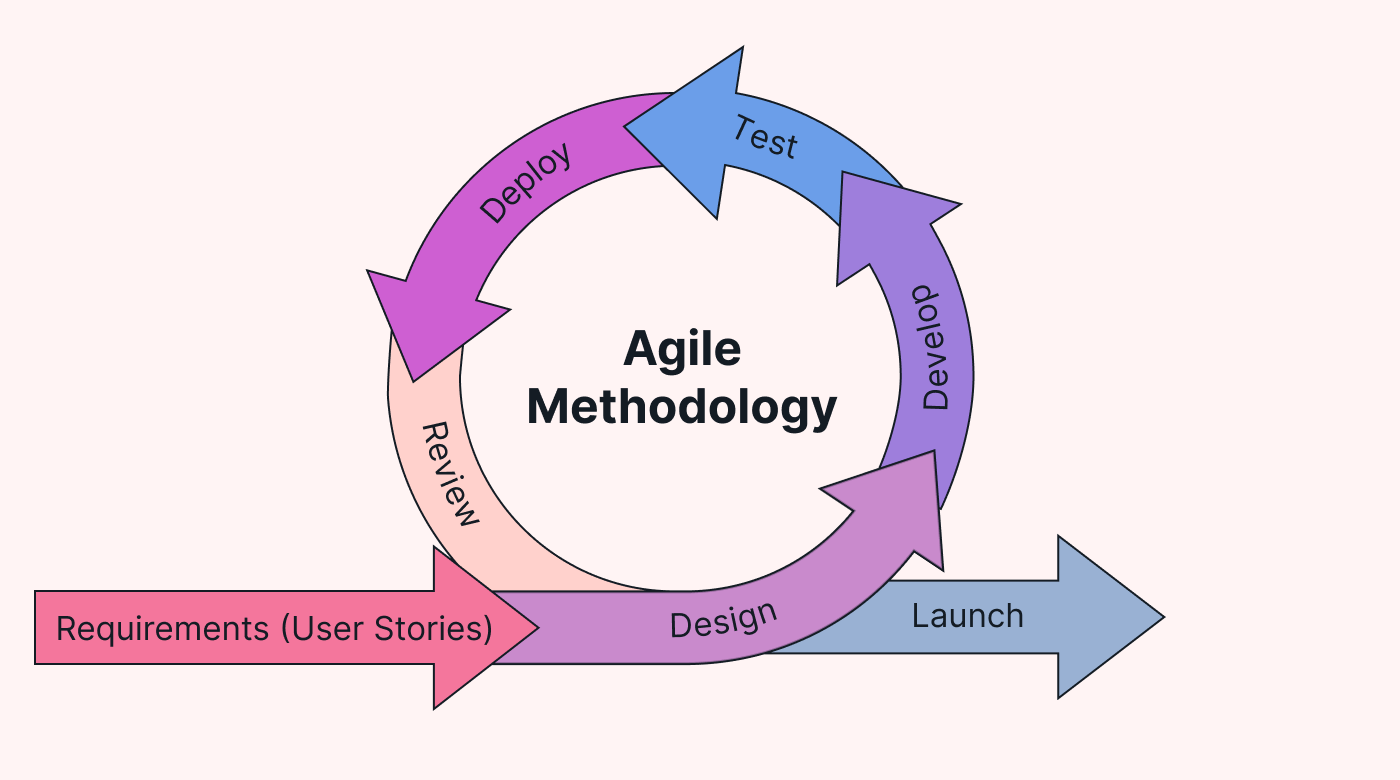
Agile Software Development Lifecycle: From Idea to Retirement
The Agile lifecycle is not limited to short Sprints; it requires a holistic view from the moment a product is conceived until it reaches the end of its lifecycle. Below are the six main phases of the Agile SDLC, each deeply rooted in iterative and adaptive thinking.
1. Concept Phase
Objective: Define the fundamental “why” and “what” of the product.
Key activities:
- Identify market opportunities and user problems to be solved.
- Outline the Product Vision and high-level scope.
- Conduct an initial feasibility assessment covering business, technical, and resource aspects.
Outcome: A Project Charter and an initial set of high-level features (Epics) in the Product Backlog.

2. Inception Phase (Inception / Sprint 0)
Objective: Prepare everything required to begin formal development Sprints.
Key activities:
- Form a cross-functional project team.
- Set up the development environment, tools, and a basic CI/CD pipeline.
- Clarify and prioritize the highest-value Epics, which may begin to be broken down into User Stories.
- Create a high-level Release Roadmap with major milestones.
Note: This is a preparation phase and should be time-boxed (typically 1–2 weeks) to quickly move into delivering real value.
3. Construction Phase (Construction / Iterative Development)
Objective: Build working software through a sequence of iterative Sprints.
Key activities:
- This is the core of Agile, where consecutive Sprint cycles take place.
- Each Sprint includes planning → design/coding → testing → review.
- The product evolves incrementally and is continuously improved based on feedback.
- The Product Backlog is continuously refined, and the Release Plan is flexibly updated.

4. Release Phase
Objective: Finalize and deliver the product to the market.
Key activities:
- Finalization work (Release Sprint): focusing on performance testing, security testing, documentation completion, and user training.
- Final User Acceptance Testing (UAT) with customers.
- Official deployment to the production environment.
Outcome: A stable product version ready for end users.
5. Production and Maintenance Phase
Objective: Ensure stable operation and continued value delivery.
Key activities:
- Monitor system performance, support users, and resolve incidents.
- Collect feedback from real market usage.
- Enhancements, new features, or defect fixes are added to the Product Backlog.
- The team proceeds with new Sprints for the next version or maintenance features, restarting the loop from the Construction phase. This represents the long-term evolution of the product.
6. Retirement Phase
Objective: Gracefully and systematically discontinue the product.
Key activities:
- Announce end-of-life (EOL) and end-of-support.
- Provide migration paths for users to replacement solutions, if available.
- Decommission the system and archive data in accordance with regulations.
- Capture lessons learned to inform future product initiatives.
Advantages and Disadvantages of Agile Software Development
Advantages of Agile Software Development
- High Flexibility and Adaptability: The greatest strength of Agile lies in its ability to adapt. The iterative model enables teams to respond quickly to changes in requirements, technology, and market conditions.
- Improved Customer Satisfaction: Agile emphasizes close collaboration with customers.
Regular reviews and feedback loops ensure that the final product aligns closely with customer expectations and real needs. - Faster Time to Market: Small, usable product increments are delivered within short Sprints.
This allows organizations to gain a competitive advantage and generate value early. - Higher Product Quality: Practices such as Continuous Integration (CI), Daily Stand-ups, and Test-Driven Development (TDD) are commonly applied.
Defects are identified and resolved early, while code quality is continuously maintained. - Reduced Risk: The iterative delivery model enables early identification and mitigation of risks.
Frequent testing, reviews, and feedback help prevent issues from escalating into major problems. - Better Team Collaboration: Agile fosters a collaborative environment with frequent communication.
This leads to better coordination, higher team morale, and stronger team cohesion. - Greater Transparency: Transparent processes and tools such as Scrum boards and burndown charts provide stakeholders with clear visibility into project progress.
Disadvantages of Agile Software Development
- Risk of Scope Creep: Agile’s flexibility can sometimes result in continuous changes and additions to scope.
This may extend project timelines and place strain on resources. - Insufficient Documentation: Agile prioritizes working software over comprehensive documentation. This can create challenges for long-term maintenance and onboarding new team members.
- Dependence on Team Experience: Agile relies heavily on the skills and expertise of the team.
Inexperienced teams may struggle to effectively adopt and execute Agile practices. - Potential Management Overhead: Frequent meetings (planning, reviews, retrospectives) can introduce management overhead.
They may consume a significant portion of team time that could otherwise be spent on development. - Dependence on Strong Leadership: Successful Agile implementation requires strong leadership roles, such as the Scrum Master and Product Owner. Lack of effective leadership can hinder Agile adoption and reduce its overall effectiveness.
Conclusion
Agile Software Development is a mindset focused on delivering continuous customer value through adaptability, collaboration, and iterative improvement. By applying Agile frameworks and practices effectively, organizations can respond to change faster, improve product quality, and reduce risk throughout the software lifecycle. While Agile requires experienced teams and strong leadership to succeed, its emphasis on flexibility and value-driven delivery makes it a powerful approach for building sustainable and competitive software products in today’s dynamic environment.
ニュースレターを購読する
最新のニュースをお届けします。
ニュースレターを購読する
最新のニュースをお届けします。