Top Mobile App Development Technologies & Frameworks in 2026
In the digital era of 2026, mobile app development for enterprises is no longer merely about building a customer touchpoint; it is a strategic equation of optimizing TCO (Total Cost of Ownership) and accelerating Time-to-Market. Choosing the wrong underlying architecture from the start can lead to massive "technical debt," creating bottlenecks during scale-up phases or when integrating with legacy systems such as ERP and CRM.
Facing the challenge of balancing performance and cost, what is the most optimal solution? This article provides an in-depth analysis and evaluation of today's leading mobile app development technologies and frameworks, based on core enterprise criteria: security, scalability, and operational performance.
Native mobile technologies: The gold standard for performance and security
In 2026, despite the surge in cross-platform solutions, Native remains the mandatory choice for enterprise applications requiring complex data processing, AI/AR integration, or stringent security requirements (Fintech, Healthcare). When implementing Native, your technology stack will be shaped by the best languages for mobile app development provided directly by Google and Apple.

See more: Top Offshore Software Development Companies in Vietnam 2026
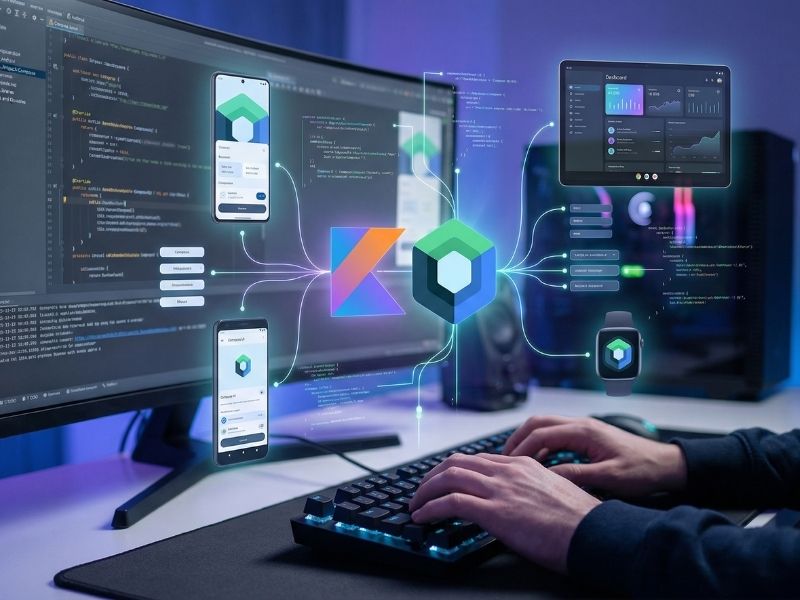
The Android Ecosystem: Kotlin and Jetpack Compose
Current Landscape in 2026: While Java persists within legacy systems, the modern Android platform is now dominated by Kotlin combined with the Jetpack Compose UI framework.
Enterprise Advantages:
- High Stability: Kotlin’s safe syntax eliminates classic system errors (such as app crashes due to null pointer exceptions), ensuring seamless application operation.
- Rapid Development: The Jetpack Compose framework allows developers to build interfaces with significantly less code, accelerating the time-to-market for new features.
- Effortless Integration: Kotlin is 100% interoperable with Java, enabling businesses to easily upgrade and maintain existing Legacy systems without the need for a complete rewrite.
See more: Top Custom Web Application Development Companies in Vietnam
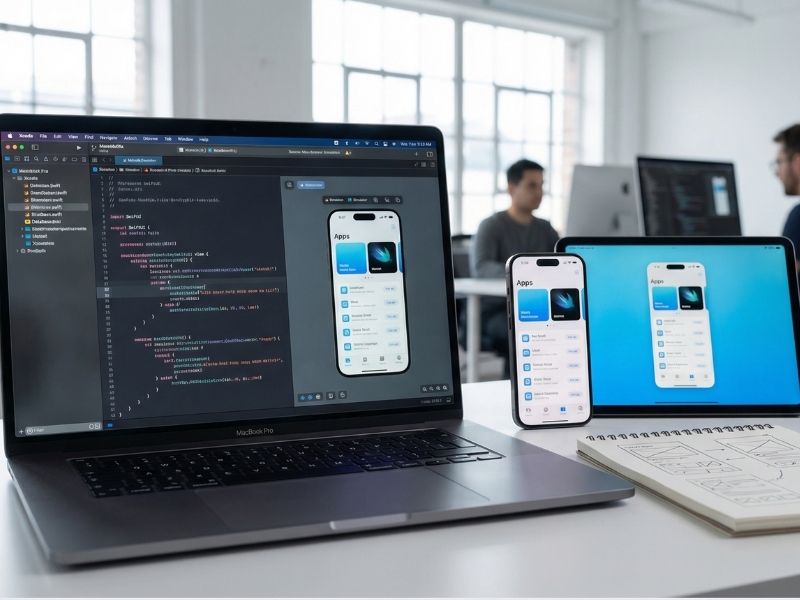
The iOS Ecosystem: Swift and SwiftUI
Current Landscape in 2026: Swift and the SwiftUI framework stand as the exclusive and most powerful toolkit for building applications across Apple’s device lineup.
Enterprise Advantages:
- Top-Tier Security: Swift is meticulously engineered by Apple to prevent source code vulnerabilities, making it the premier choice for meeting international data security standards.
- Cross-Device Deployment (Ecosystem): A highlight of SwiftUI in 2026 is its "write once, deploy everywhere" capability for UI code, ensuring perfect compatibility across the entire Apple device spectrum—from iPhone and iPad to the Vision Pro headset.
- Premium User Experience (UX): No cross-platform framework can 100% replicate the fluid animations and instantaneous response times on iOS as effectively as Native Swift.
See more: Custom Web Application Development: Complete Guide for 2026
Cross-Platform Frameworks: Strategies for TCO Optimization and Accelerated Time-to-Market
In 2026, the pressure to launch products simultaneously on both iOS and Android is greater than ever. For enterprises needing rapid market testing or building internal tools and B2B apps, Cross-Platform is no longer just a temporary MVP (Minimum Viable Product) solution; it has become a core strategy for optimizing Total Cost of Ownership (TCO). By utilizing a single codebase, businesses can address talent shortages and significantly accelerate deployment cycles.
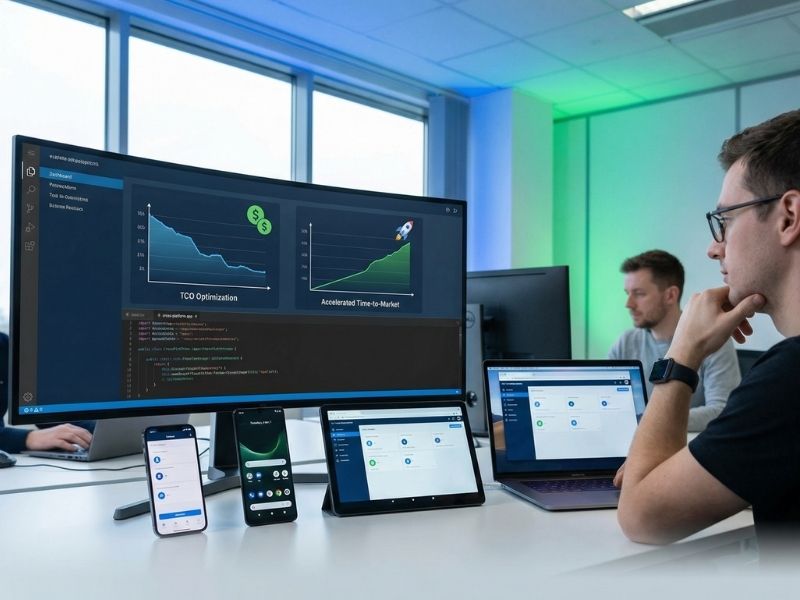
Flutter (Powered by Dart): Near-Native Performance and UI Consistency
Current Landscape in 2026: Backed by Google, Flutter (using the Dart language) has reached a high level of maturity. With next-generation graphic rendering engines, Flutter is currently the smoothest cross-platform framework, achieving performance nearly indistinguishable from Native applications.
Enterprise Advantages:
- 40-50% Reduction in Development Costs: Instead of maintaining separate iOS and Android teams, businesses only need a single squad to develop and maintain code for both platforms (and even Web).
- 100% Brand Identity Consistency: Flutter renders its own UI components rather than relying on the operating system. This ensures your enterprise application looks identical across all devices, maintaining strict brand integrity.
- Ultra-fast Time-to-Market: The Hot Reload feature allows developers and QA teams to see changes instantly without rebuilding the app, significantly speeding up the feature refinement cycle.
React Native (Power from JavaScript): Maximizing Internal Resources
Current Landscape in 2026: Developed by Meta, React Native remains a dominant force thanks to its use of JavaScript—the world's most popular programming language. By 2026, its new architecture has effectively resolved previous latency issues (bottlenecks) when communicating with device hardware.
Enterprise Advantages:
- Human Resource Optimization: This is React Native's absolute competitive edge. Businesses can leverage existing Web (Frontend) engineering teams to participate in mobile development without the overhead of recruiting expensive Native specialists.
- Over-The-Air (OTA) Updates: Enterprises can push urgent hotfixes or minor UI changes directly to user devices, bypassing the lengthy approval wait times of the App Store or Google Play.
- Ecosystem Scalability: Thanks to the massive JavaScript ecosystem, React Native boasts thousands of ready-to-use libraries, enabling enterprise projects to integrate rapidly with third-party services like payment gateways, CRMs, or analytics systems.
Compare: Native Technologies vs. Cross-Platform Frameworks
| Evaluation Criteria | Native Mobile Technologies (Java, Kotlin, Swift) | Cross-Platform Frameworks (Flutter, React Native) |
|---|---|---|
| Strategic Goal | Maximize performance and experience quality (Premium UX). | Optimize Total Cost of Ownership (TCO) and accelerate delivery time. |
| Upfront Cost | Very High. Requires maintaining two separate teams (iOS & Android). | Low to Medium. Saves 40-50% on labor costs due to a single codebase. |
| Time-to-Market | Slow. Independent development cycles with separate testing on each platform. | Fast. Simultaneous deployment to both app stores. Hot-reload accelerates progress. |
| Performance & Fluidity | Excellent. Direct hardware interaction with zero latency. Maximum FPS. | Good to Great. Framework-dependent (Flutter is near-native), but heavy graphics may lag. |
| Hardware Interaction & Security | Absolute. Deep access to Camera, GPS, Biometrics. Easily meets stringent security standards. | Limited. Relies on third-party plugins for hardware access. Slightly higher security risks. |
| Maintenance & Updates | Complex. Bug fixes or feature updates must be performed twice on different platforms. | Highly Synchronized. One fix updates both platforms. Supports rapid OTA updates. |
| Platform-Related Risks | None. Direct and early support for all new features from Apple and Google. | Present. Must wait for community or framework updates when new OS versions launch. |
| Best Fit For | Core Banking, Healthcare, High-end Games, AR/VR Apps, Legacy Systems. | Internal B2B Apps, E-commerce, SaaS Mobile, Startups needing rapid MVP testing. |
The performance gap between these two methodologies is narrowing rapidly, thanks to advancements in AI and next-generation graphic rendering engines. The decision to choose between Native and Cross-Platform is no longer a question of "which technology is superior," but rather depends entirely on the budget, existing human resources, and the specific nature of the project that the enterprise is targeting.
See more: The 10 Best Custom Software Development Companies Worldwide
The platform & tooling ecosystem: Maximizing development productivity
To move a mobile app project from a theoretical blueprint to a timely market launch, choosing the right framework is only the beginning. In 2026, the true competitive edge for development teams lies in the Development Tools ecosystem. These technological levers empower enterprises to optimize engineer productivity, minimize errors, and significantly shorten Time-to-Market.
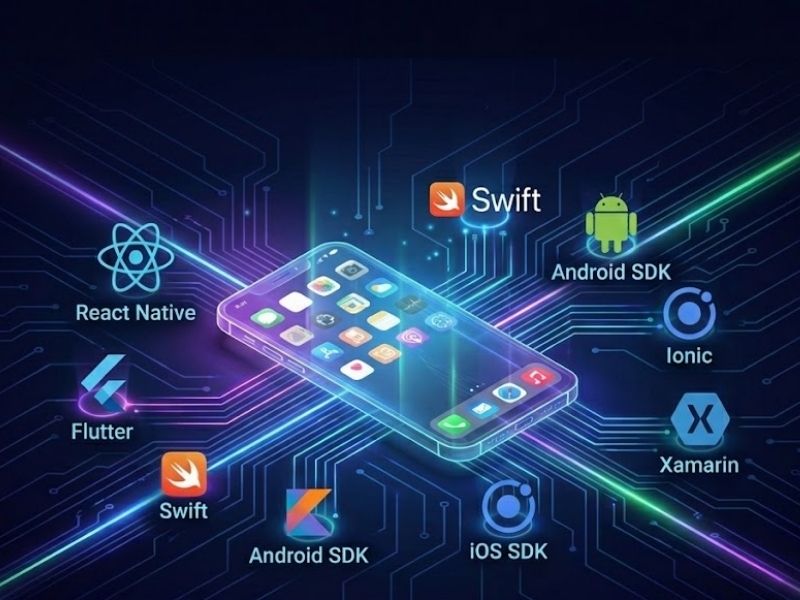
Integrated Development Environments (IDEs) & AI Assistants: Accelerating Code Production
IDEs such as Xcode (for iOS), Android Studio (for Android), and Visual Studio Code (for Cross-platform) are the essential "workshops." However, the current differentiator in labor costs is the deep integration of Artificial Intelligence.
- AI Automation: Utilizing AI assistants (such as GitHub Copilot or Tabnine) directly within the IDE helps developers automate repetitive boilerplate code and reduce basic logic errors.
- Resource Optimization: This technology can boost coding productivity by 30-40%, directly reducing billable hours and overall Development Costs for the enterprise.
Design-to-Code Platforms: Bridging the Gap Between Design and Engineering
Discrepancies between UI/UX blueprints and the actual application (interface bugs) are a constant cause of delays. Handoff platforms like Figma (with Dev Mode) or Zeplin have effectively eliminated this "pain point."
- Pixel-perfect Accuracy: These platforms allow developers to extract precise technical specifications (color codes, spacing) or export preliminary interface code blocks directly.
- Time Reduction: This workflow cuts hundreds of hours of back-and-forth meetings between departments, ensuring the final app aligns 100% with the corporate brand identity.
Local Databases: Ensuring an "Offline-first" Experience
An enterprise application—especially in logistics, warehousing, or internal B2B—must operate smoothly even without a network connection. Local storage solutions like Realm, SQLite, or Watermelon DB are indispensable components.
- Seamless Synchronization: Applications can store and process data instantly on the user's device, then automatically sync with the server once an internet connection is restored.
- On-device Security: Data stored on the device is protected by End-to-End Encryption (E2EE), meeting stringent security standards to prevent internal information leaks.
Specialized SDKs: Integrating On-device AI and AR
Enterprises do not need to build AI or Augmented Reality (AR) systems from scratch. Native SDKs like Core ML / ARKit (Apple) and ML Kit / ARCore (Google) allow these advanced features to be embedded directly into the application.
- On-device Processing: Apps can perform facial recognition, barcode scanning, or text analysis right on the phone without sending data to the cloud.
- Safety and Speed: This enables Zero-latency responses while completely eliminating the risk of sensitive customer data being intercepted during transmission.
Conclusion
While technological boundaries are blurring, management principles remain unchanged: there is no "one-size-fits-all" platform for every project. The decision to choose between the absolute performance of Native (Kotlin, Swift) or the TCO optimization of Cross-platform (Flutter, React Native) must ultimately stem from the core business objectives of the enterprise. It is a calculated balance between Upfront Investment Costs, Time-to-Market, and the Scalability vision for the next 3 to 5 years.
Selecting the right toolkit and software architecture from the starting line is the most cost-effective risk management strategy, helping businesses avoid massive "technical debt" when the system needs to scale.
See more: Top 10 Leading Mobile App Development Companies
Realize Your Vision with KIMEI Global
Defining the technology architecture for an Enterprise Mobile App requires deep insights not just into technical specifications, but into the long-term business roadmap.
At KIMEI Global, we understand that businesses don't just need an app that works; they need a genuine growth engine. With specialized expertise in building complex mobile solutions, combined with the power of AI and the most advanced frameworks, KIMEI Global is ready to partner with you from the initial blueprint to dominating the market.
What We Deliver:
- Strategic Architectural Consulting: We accurately assess your "pain points" to recommend the platform (Native or Cross-platform) that delivers the highest Return on Investment (ROI).
- Tailor-made Solutions: We build modern UI/UX systems with seamless data synchronization that meet the most stringent security standards.
- Core Tech Integration: Achieving comprehensive digital transformation by embedding intelligent features (AI/ML) and automation directly into your application.
Don't let technological barriers slow down your business's growth momentum. Let KIMEI Global help you solve this equation.
Book a 1-on-1 Strategic Consultation with KIMEI Global’s Technology Experts Today
Get customized solutions for Mobile Apps, Web Apps, AI, and IoT tailored to your specific business model.
Book Your Consultation NowSubscribe To Our Newsletter
Stay update with our latest news.
Subscribe To Our Newsletter
Stay update with our latest news.