How Much Does Mobile App Development Cost in 2026?
In the booming digital era, developing a mobile application is no longer merely about being "present" on the App Store or Google Play. Today’s competition lies in user experience, speed, and personalization. Notably, with the rapid advancement of AI, applications are becoming increasingly intelligent in understanding and serving user needs. Consequently, owning a mobile app is no longer just an advantage; it is becoming a mandatory factor for any business seeking sustainable growth.
However, before diving into development, most founders share a common question: How Much Does It Cost to Build an App? In reality, there is no fixed price tag for mobile app development. The investment can fluctuate significantly depending on various factors such as the type of application, the technology stack utilized, the complexity of features, and the development partner.
In this article, we will explore the costs of top-tier mobile app development, identifying the factors with the greatest impact on your budget and the hidden costs that businesses must consider. Finally, we will guide you in selecting the most suitable mobile app development partner for your enterprise today. Let’s explore a detailed budgetary roadmap to transform your "million-dollar idea" into reality in the most optimal way possible.

An Overview of Mobile App Development Costs: What You Need to Know
Depending on the business goals and the level of investment, the cost of developing a mobile application varies significantly. For basic applications, costs typically range from $25,000 to $150,000. Meanwhile, complex applications integrated with advanced features such as AI, real-time capabilities, or massive backend infrastructures can exceed $300,000.
However, providing an exact figure for every project is challenging. The cost of mobile app development depends on several key factors, including:
- Application Complexity: Features and system scale.
- Development Platform: iOS, Android, or Cross-platform.
- UX/UI Design Investment: The depth of user experience and interface design.
- Expertise and Capacity: The experience of the development team.
- Post-launch Costs: Operation, maintenance, and future upgrades.
To obtain a realistic estimate, it is essential to understand each factor influencing the budget. In the following section, we will analyze and compare popular mobile app types, helping you evaluate the best fit for your business through our "Quick Comparison Table of Popular App Types in 2026" and strategies for effective budget optimization.

Quick Comparison Table of Popular App Types in 2026
| App Category | Key Characteristics | Estimated Cost (USD) | Timeline |
|---|---|---|---|
| Simple (MVP) | Basic features, Simple UI. | $15,000 – $80,000 | 1–3 months |
| Medium | Custom UI, API integration, Payment gateways. | $80,000 – $150,000 | 3–6 months |
| Complex |
AI-driven, Fintech, Large-scale Marketplaces. |
$150,000 – $400,000+ | 6–12 months |
| Enterprise |
High-security systems, Millions of users. |
$500,000+ | 12 months+ |
See more: How to Build a Web Application
Key Factors Influencing Mobile App Development Costs
The cost of developing a mobile application is never static. To establish an accurate budget, multiple variables must be considered. By understanding each factor, you can effectively control costs and make informed decisions that align with your business objectives.

Application Complexity
When addressing the question, “How much does it cost to build an app?”, the first priority is defining the level of complexity.
See more: How Much Does Custom Software Development Really Cost
Simple Applications ($10,000 – $50,000)
This is the optimal choice for rapid market entry with minimal investment.
Characteristics:
- Basic features with minimal interaction (e.g., to-do lists, calculators).
- Minimalist design focused on ease of use.
- Developed for a single platform (iOS or Android).
- Simple backend with limited data storage.
- Basic API integration (Social login, simple data fetching).
- Standard security (Password-based authentication).
- Low maintenance requirements; infrequent updates.
Best For: Testing concepts or launching an Initial MVP.
Medium-Complexity Applications ($50,000 – $120,000)
The most common choice for startups and enterprises expanding their digital product lines.
Characteristics:
- Expanded feature sets with smoother user flows.
- Modern, professionally invested UI/UX design.
- Multi-platform support (iOS, Android, Web).
- Robust backend for complex data processing.
- Third-party integrations (Payments, CRM, Analytics).
- Advanced security (Encryption, secure authentication).
- Regular maintenance and feature updates.
Best For: Products with a clear roadmap and a need for Scalability.
Complex Applications ($100,000 – $300,000+)
Tailored for large-scale products, ecosystem-driven apps, or high-tech solutions.
Characteristics:
- Advanced features with complex business logic.
- High-end, meticulously refined UI/UX for a premium experience.
- Seamless multi-platform performance with optimized efficiency.
- Powerful backend (Real-time processing, Big Data, AI).
- Deep integrations (IoT, AI/ML, AR/VR).
- Enterprise-grade security and periodic penetration testing.
- Continuous maintenance and market-driven updates.
Best For: Large enterprises or "Core Business" digital products.
Application Features
Following complexity, features are the factors that most directly impact your budget. The principle is clear: the more features, the higher the cost. The difference between a $30,000 app and a $150,000 app typically lies in the volume and technical difficulty of its features.
An effective cost-optimization strategy widely adopted by businesses today is MVP Software Development. Instead of developing everything from the start, a business focuses only on core functionalities to launch quickly for market testing. This allows for gathering user feedback and iterating based on real-world data. This approach minimizes upfront costs, reduces the risk of failure, and increases the overall success rate of the product.
Common Features Impacting Development Costs:
- Booking & Scheduling
- Image Recognition (AI)
- QR Code Scanning
- Voice Recognition
- E-wallet / Payment Integration
- User Data Analytics
- Social Media Sharing
- Wearables Integration
- Gamification (Points, Levels, etc.)
- Offline Mode
- Multi-language Support
- AI Chatbots
- Biometrics (Fingerprint, Face ID)
- Multi-device Synchronization
Beyond complexity and features, the rapid evolution of technology is significantly altering development costs. Here are the critical factors you cannot afford to overlook:
Technological Factors: The AI Explosion
Beyond complexity and features, rapid technological evolution is significantly shifting development costs. While AI was once a mere "add-on," by 2026, it has become a core factor determining the success of many applications.
AI Integration via APIs (Gemini, GPT, etc.)
Businesses can leverage pre-built AI models through APIs. This method saves on initial development costs but incurs ongoing expenses based on usage (pay-as-you-go). As your user base grows, operating costs will scale accordingly.
Custom AI Model Development
For products requiring high security or industry-specific logic, enterprises need to develop proprietary AI. Costs include: data collection and processing, model training and fine-tuning, and computational infrastructure (GPU/Cloud). While this requires a substantial upfront investment, it yields a sustainable competitive advantage and superior data control.
Platforms: Native vs. Cross-platform
Native Development (Kotlin – Android, Swift – iOS)
- Requires two separate dedicated teams.
- Higher overall cost
- Optimized performance and seamless user experience.
Best for high-performance apps like games, video editors, or complex systems.
See more: Mobile App Development Technologies & Frameworks
Cross-platform (Flutter, React Native)
- One codebase for multiple platforms.
- Reduced development time and costs.
- Easier maintenance and updates.
The preferred choice for most startups due to budget optimization without compromising quality.
Mobile App Development Costs by Phase
To manage budgets effectively, breaking a project down into distinct phases is mandatory. At KIMEI Global, we apply a transparent process that empowers businesses to maintain better control over their cash flow.
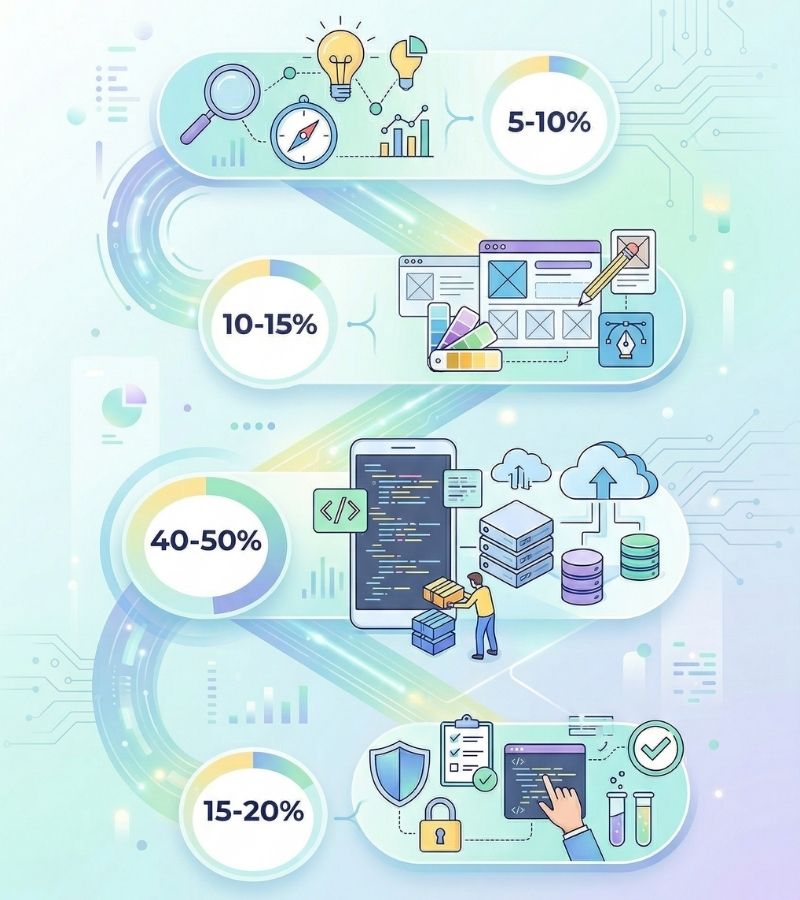
Discovery & Planning (5-10% of Budget)
This is the "foundation" of your project. Instead of rushing into coding, our experts focus on:
- Market & Competitor Research: Identifying unique differentiators for your app.
- SRS (Software Requirement Specification) Documentation: A detailed technical blueprint ensuring 100% alignment between the development team and the client.
- AI Architecture Planning (if applicable): Mapping out data model integration.
A clear Roadmap that minimizes the risk of unexpected costs later.
UI/UX Design (10-15% of Budget)
User experience is the deciding factor in an app's success. This phase focuses on creating intuitive, easy-to-use interfaces optimized for user behavior.
- Wireframes: Skeletal outlines of the app's structure.
- Prototyping: Interactive models that allow you to "feel" the app before programming begins.
- User Testing: Real-world experience checks to refine the interface for maximum engagement.
Development – Programming & Infrastructure (40-50% of Budget)
This is the largest investment phase, where ideas are transformed into functional products:
- Frontend Development: Crafting seamless interfaces using Jetpack Compose or Flutter.
- Backend & Database: Building the "brain" to store data and handle complex business logic.
- Cloud Infrastructure: Setting up AWS, Google Cloud, or Azure to ensure stability during peak traffic with millions of concurrent users.
QA & Testing – Quality Assurance & Security (15-20% of Budget)
While often overlooked, this phase is critical for protecting your brand reputation:
- Automation Testing: Using automated tools to verify performance across hundreds of different device types.
- Security Audit: Crucial for apps handling financial or personal data, defending against the sophisticated cyber-attacks of 2026.
- Beta Testing: Releasing a trial version to a small user group for final feedback.
Hidden Costs that 90% of Founders Overlook
A common mistake among founders is allocating their entire budget to the initial development phase while forgetting one crucial fact: Launching the app on the Store is only the beginning. Below are the hidden costs you must include in your long-term financial planning:

Maintenance & Updates
Building the app doesn't mean the work is finished. To keep the application running smoothly, you must budget for:
- Bug Fixes: New issues inevitably arise as the user base scales.
- OS Updates: Every time Google (Android) or Apple (iOS) releases a new version, your app must be optimized to prevent obsolescence.
- Estimated Cost: Typically 15-20% of the initial development cost per year.
Cloud Infrastructure & AI Tokens
Most applications run on cloud platforms rather than physical servers:
- Cloud Hosting: Ongoing fees for maintaining databases on AWS, Google Cloud, or Azure. These fees scale with your user count.
- AI API Tokens: If your app utilizes artificial intelligence (e.g., chatbots, image recognition), you must pay for every request sent to models like Gemini or OpenAI.
Store Maintenance Fees
To keep your app live in the official ecosystem, you must pay mandatory fees to platform providers:
- Apple Developer Program: $99/year (annual recurring fee).
- Google Play Console: $25 (one-time registration fee).
Marketing & ASO (App Store Optimization)
A great app that no one knows about is a failed app. You will need a budget for:
- ASO: Optimizing keywords and visuals to ensure your app ranks at the top of Store search results.
- User Acquisition: Advertising costs (Facebook, Google, TikTok) to acquire your first wave of users.
- Branding: Building brand authority for your application across social media platforms.
KIMEI Global’s Advice: We always advise clients to reserve at least 20-30% of their total projected budget for these operational and marketing expenses. This ensures the project remains financially viable and doesn't stall immediately after launch.
Strategies to Optimize Mobile App Development Costs
Is it possible to reduce development costs without compromising quality? Absolutely—provided you apply the right strategies from day one. At KIMEI Global, we recommend these four core methods:
Prioritize MVP (Minimum Viable Product) Development
Instead of building a "super-app" with dozens of features immediately, focus on a Minimum Viable Product.
- Identify Core Functionalities: Focus on 2-3 features that directly solve the user’s primary pain points.
- Real-world Learning: Launching an MVP allows you to enter the market earlier, gather authentic feedback, and invest only in features that users truly need.
Benefit: Saves 40-60% of the initial budget and prevents waste on unused features.
Leverage Cross-platform Development
Instead of developing separately for iOS and Android, utilize modern frameworks like Flutter or React Native. You only need to invest in one development team to create an app that runs seamlessly on both platforms. Future updates and bug fixes occur simultaneously, significantly cutting long-term operational costs.
Partner with Professional Outsourcing Units
Building an in-house team requires substantial expenses for recruitment, office space, and benefits. Partnering with a firm like KIMEI Global offers distinct advantages:
- Access to Expertise: Instant access to a high-level team experienced in complex fields like AI, Blockchain, or Cloud without the need for internal training.
- Efficiency Management: We utilize transparent communication channels and international Agile processes to eliminate delays—the leading cause of budget overruns.
Prioritize Early QA (Quality Assurance)
The biggest mistake is waiting until the app is finished to start finding bugs. "Fixing a bug during the design phase costs $1, but fixing it after the app is live on the Store can cost $100."
- Continuous Testing: Regular testing throughout the coding process ensures immediate issue detection.
- User Acceptance Testing (UAT): Involving end-users early to identify usability issues avoids the need for costly interface overhauls after launch.
Our Philosophy: KIMEI Global’s goal is not to build the cheapest app, but to deliver the best Return on Investment (ROI) for your business.
See more: Best Custom Software Development Companies
Why is KIMEI Global Your Trusted Mobile App Development Partner?
Among hundreds of software development firms, KIMEI Global stands out as a strategic partner, transforming complex ideas into mobile applications that exceed expectations. We don't just build software; we build sustainable business value for you.
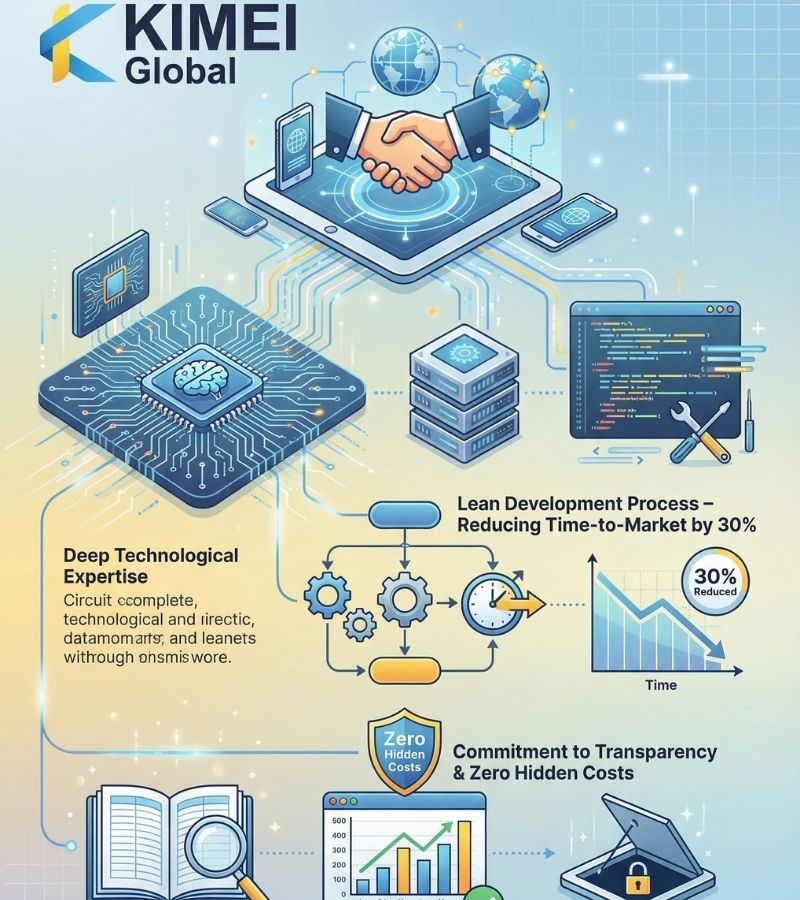
Deep Technological Expertise
The tech world changes daily, and we are constantly mastering the latest innovations. The engineering team at KIMEI Global is proficient in today's most pioneering technologies:
- Jetpack Compose & Swift: Crafting modern, seamless interfaces with optimized performance.
- AI Integration: Embedding Artificial Intelligence (LLMs, Computer Vision, Predictive Analytics) into applications to create breakthroughs in user experience.
- Cloud-Native: Ensuring your system is always ready to scale in alignment with your business growth.
Lean Development Process – Reducing Time-to-Market by 30%
Time is money. With our standard Agile workflow, KIMEI Global helps you significantly shorten the duration from ideation to App Store launch:
- Eliminating redundant procedures to focus directly on core values.
- Parallel development and continuous testing ensure faster completion without compromising absolute quality.
- Helping your business capture market share before competitors can react.
See more: Top 10 Leading Mobile App Development Companies
Commitment to Transparency & Zero Hidden Costs
The greatest fear for any Founder is the "invisible" fees that appear mid-project. At KIMEI Global, transparency is our guiding principle:
- Detailed Quotations: Every expense is clearly broken down from the initial consultation phase.
- Transparency in Every Line of Code: You maintain full ownership of the source code and can track project progress in real-time.
- No Hidden Fees: We commit to executing the agreed scope of work without any unexpected additional charges.
Subscribe To Our Newsletter
Stay update with our latest news.
Subscribe To Our Newsletter
Stay update with our latest news.